K-1 season usually starts the same way. Sometime in late January, a fund controller opens a spreadsheet that hasn't been touched since last April and stares at a list of 300 limited partners. Some have moved. Several have multiple K-1/K-3s across different fund vehicles. Three are foreign nationals with state-specific filing requirements. And the first investor call asking about timing is already on the calendar.
This is the moment - not a compliance failure, not a missed deadline - when fund managers realize their current approach to tax operations is structurally broken. The process that worked at 50 LPs doesn't scale to 150. The process at 150 starts cracking under 300. And the expectation from institutional investors hasn't moved: K-1/K-3s land accurately, on time, and with zero back-and-forth.
The funds that get this right aren't necessarily larger or better-resourced. They've made a deliberate operational choice. They've moved K-1/K-3 preparation off a patchwork of spreadsheets and into a structured, auditable workflow - one where AI handles the volume work and licensed CPAs own every number that goes out the door.
Why K-1 Preparation Is Harder Than It Looks
Ask a fund manager what keeps them up during tax season and they'll give you a long list. Ask an outside observer why the process is hard and they'll underestimate it by a factor of five.
The complexity starts with volume. A fund with 400 LPs doesn't have one K-1/K-3 problem - it has 400 individual reporting obligations, each with its own investor profile, tax classification, state-level requirement, and delivery preference. One institutional LP may hold interests through multiple entities requiring separate schedules. A foreign investor may trigger FDAP reporting layers that don't apply to domestic partners.
Then there's timing. K-1/K-3s are downstream of the fund's final K-1/K-3 from portfolio companies, which are themselves downstream of audit completion. That creates a compressed window - often four to six weeks - to produce, review, and distribute hundreds of documents. Any single bottleneck in that chain cascades.
Investor expectations have also shifted. Institutional LPs have their own tax departments. They run exception reports on K-1/K-3 data against prior years. They notice discrepancies. They escalate. And fund managers who deliver late or inaccurate K-1/K-3s lose something harder to recover than time: LP confidence.
- Volume at scale: Each LP is a unique tax entity, not a copy-paste exercise.
- Structural complexity: Foreign investors, multi-entity holdings, state allocations
- Compressed timelines: Four-to-six week windows with zero slack for rework
- Institutional scrutiny: LP tax teams validate every line - errors surface fast
How Formidium Handles K-1/K-3 Preparation: The Six-Stage Workflow
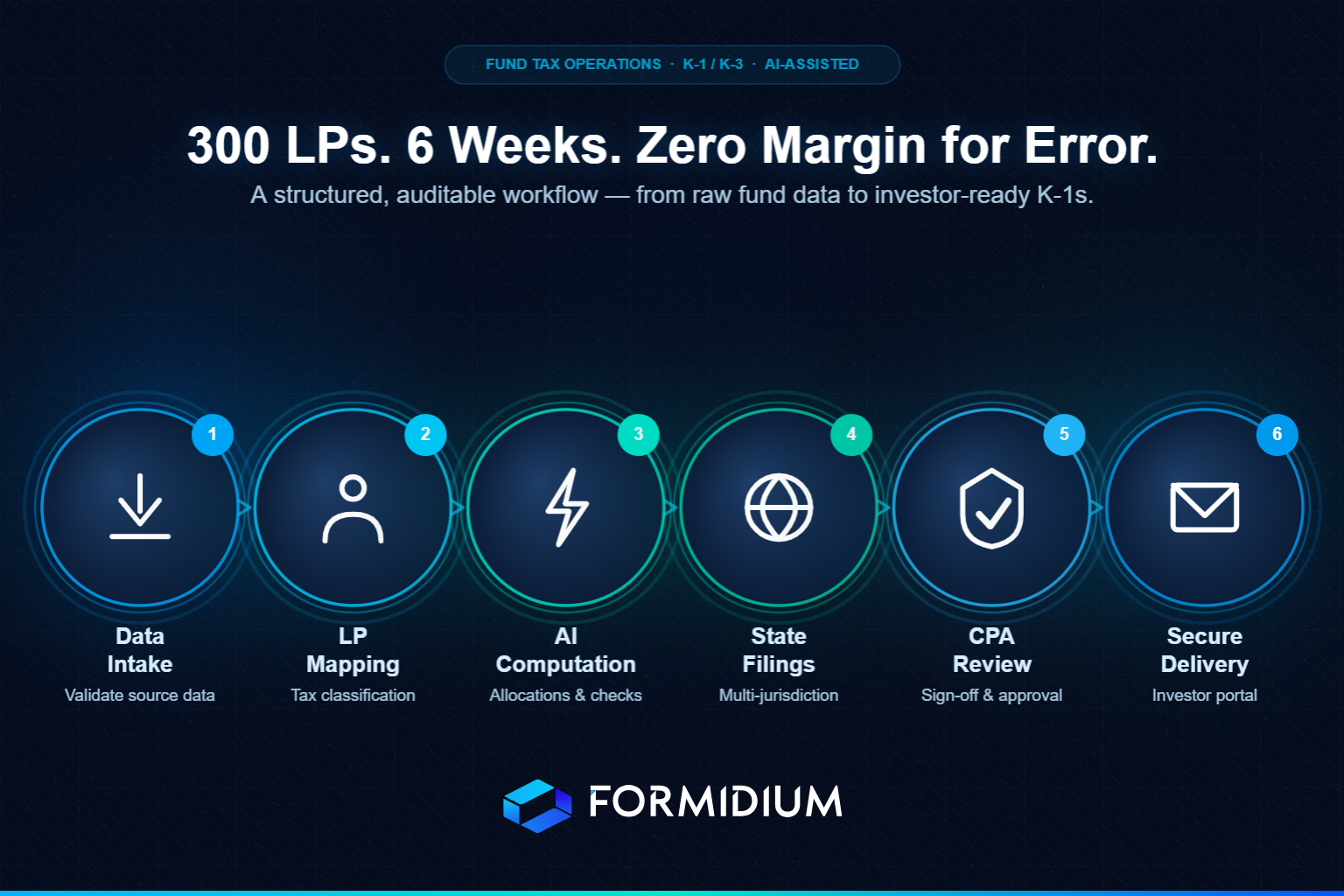
The funds that get through tax season cleanly aren't running harder - they're running a different process. Formidium's K-1/K-3 workflow is built around six stages that move from raw fund data to investor-ready documents with full auditability at every step.
1. Source Data Intake & Validation
The workflow begins with structured ingestion of trial balance data, allocation schedules, and investor capital account records. AI-assisted parsing flags formatting inconsistencies, missing fields, and data anomalies before they can propagate downstream. Nothing moves to Stage 2 until source data has passed completeness checks.
2. LP Profile Mapping & Tax Classification
Each limited partner is matched against their tax classification - domestic individual, corporation, trust, foreign national - along with entity-level attributes that determine which schedules and supplemental forms apply. This is where the multi-entity complexity gets resolved, not discovered at the end.
3. AI-Assisted Allocation Computation
Income, gain, loss, deduction, and credit amounts are allocated across LP profiles using fund-specific waterfall logic. AI handles the computation volume and consistency checks; licensed CPAs review output against allocation agreements and prior-year positions. The system flags material variances for human review rather than passing them silently.
4. State & Multi-Jurisdiction Filing Preparation
For funds with LP activity across multiple states, Formidium prepares composite state filings and apportionment schedules in parallel with federal preparation. State deadlines, nexus rules, and LP-specific residency attributes are embedded in the workflow - not handled ad hoc.
5. CPA Review & Sign-Off
No K-1/K-3 is released without licensed CPA review and approval. This isn't a checkbox - reviewers have access to the full audit trail, source data, and computation logic. Exceptions are resolved and documented before documents are finalized. This is the control point that makes everything upstream defensible.
6. Secure Investor Delivery & Acknowledgment Tracking
Finalized K-1/K-3s are delivered through Formidium's secure investor portal with read-receipt tracking. Delivery status, re-send requests, and LP acknowledgments are logged in a timestamped audit trail that fund administrators can reference in LP inquiries or regulatory review.
What Scale and Credibility Look Like in Practice
When a fund manager is evaluating a tax operations partner, three questions come up every time: Can they handle our volume? Are they accountable for accuracy? And can we show an institutional LP - or an auditor - that the process is defensible?
1,000+ K-1/K-3 Returns Per Cycle
Processing approximately 1,000 returns per cycle means Formidium has seen the edge cases - the foreign investor with a mid-year transfer, the LP holding interests through a trust that changed trustees, the composite state filing where allocation methodology was disputed. Volume at this level builds pattern recognition that smaller providers simply don't have.
SOC 2 Type II Certified Controls
SOC 2 Type II certification is the operational credibility marker that institutional LPs and their advisors look for. It means Formidium's security controls, change management procedures, and data handling practices have been independently tested over time - not just documented. For fund managers fielding LP due diligence questionnaires, this closes conversations quickly.
100% CPA-Reviewed Output
CPA review on every return is the accountability layer that separates a workflow tool from a tax operations partner. Formidium's licensed CPAs don't spot-check - they own every document that goes out under their review. When an LP's tax team calls with a question, there's a human professional who can answer it.
Taken together, these three characteristics answer the core question fund managers ask when they're done with the current approach: Is there a partner I can trust to own this?
Filing Season Is Not Waiting
The funds that are already in conversation with Formidium's team are the ones that will close this filing season with clean books, satisfied LPs, and an operational process they'll want to run again next year.
The funds that wait until the calendar forces the issue will compress their timelines, push their teams, and hand their LPs a worse experience - not because of bad intent, but because they ran out of runway.
Filing season is here. Your window to act is narrow.
Fund managers who wait until March face compressed timelines, investor pressure, and zero margin for error.
The funds that move now are the ones that close the year with clean books and confident LPs.
→ Schedule your K-1/K-3 readiness review: Get in Touch
Capacity is allocated on a first-confirmed basis.
Formidium is a Chicago-based alternative fund administration platform serving private equity, hedge funds, and real assets managers. SOC 2 certified. CPA-reviewed tax operations. Purpose-built for fund complexity.
Talk to our team: Get in Touch