Your administrator's staff tenure tells you almost nothing about operational risk.
When fund managers consider switching administrators, or decide not to, one concern comes up often:
"What happens if our main contact leaves?"
It's a reasonable question. In the old fund administration model, it was the right one. Your account manager often held the context. They knew the fund history, the investor nuances, the fee structures, the exceptions, and the workarounds. When that person left, a lot of that knowledge left with them.
But that model is no longer good enough.
Operational continuity should not depend on one person staying in their seat.
The knowledge shouldn't live in one person's head
At Formidium, everything material about a fund lives in the system.
The accounting logic. The investor allocations. The fee structures. The exception history. The audit trail. The workflow status.
When an accountant moves on, their replacement isn't starting from scratch. They open the same system, see the same fund context, and continue from the same operational foundation.
No re-learning curve. No lost history. No reliance on knowledge that lives in someone's inbox.
That's the difference between a people-dependent model and a system-driven one.
Many administrators still struggle with this, not because their people aren't capable, but because their platforms weren't built to retain institutional knowledge at the system level. When the person leaves, the operational glue leaves with them.
That's the real continuity risk.
What actually protects fund operations
Continuity isn't created by headcount stability alone. It's created by architecture.
A resilient fund administration model depends on structured workflows and platform-level visibility across the fund lifecycle.
Senior practitioners still matter. They own complex judgments, client relationships, escalation decisions, and quality control. But the core operating knowledge of a fund should never depend on any one individual.
Fund data, workflow history, audit trails, and reporting processes should be embedded in the platform. That's what allows operations to continue without disruption when teams change.
The better question to ask your administrator
Instead of asking:
"How long has your team been here?"
Ask:
"If our relationship manager left tomorrow, what would change in our fund operations?"
If the answer involves re-briefing, knowledge transfer, ramp-up time, or rebuilding context, that's the risk.
It's not a people problem. It's a systems problem.
The administrators who've solved this built continuity into their infrastructure from the start. The ones who haven't will keep pointing to the strength of their people. Their people may be excellent.
That's not the point.
The point is whether your fund's operating knowledge stays intact when people move.
Continuity should be built into the platform
Fund administration is too important to depend on individual memory, informal notes, or relationship-level continuity alone.
A stronger model keeps fund knowledge structured, accessible, and embedded in the system, so operations remain consistent even as people change.
That's what modern fund managers should expect from their administrator.
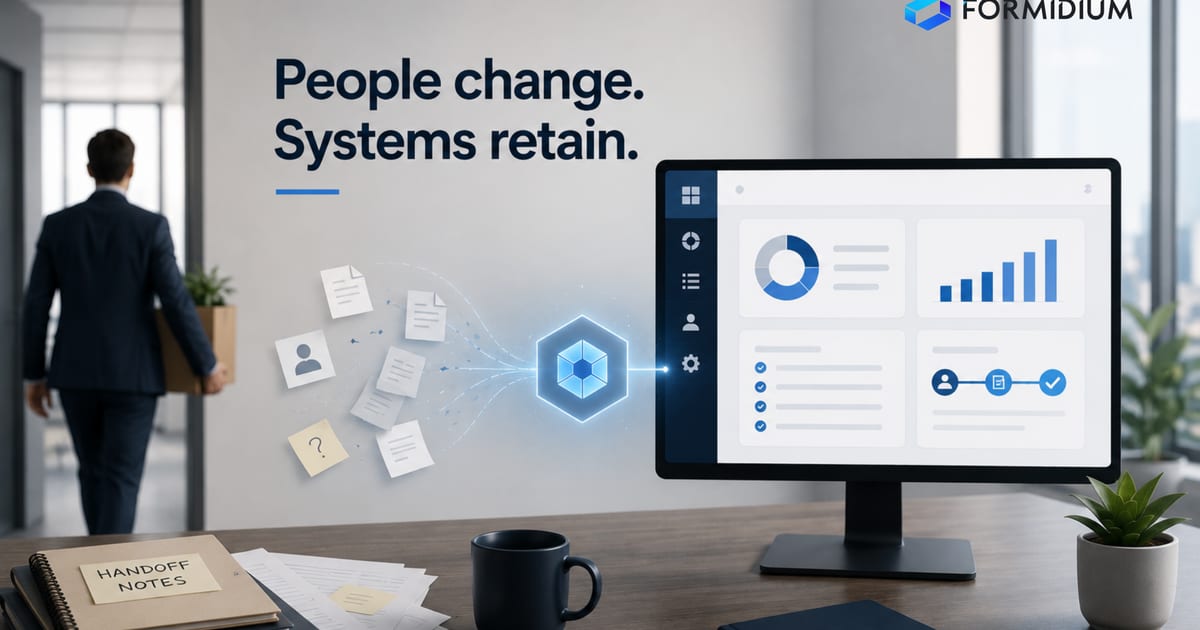
People change. Systems retain.
Related reading: Why Switching Fund Administrators Feels Hard and Why It Doesn't Have to Be
About the Author
Mandar Mhatre is Global Chief Revenue Officer at Formidium and leads the firm's European buildout. Previously India CEO for EPIC Investment Partners and Apex Group, he began his career in equity research before moving into investment banking and served as interim Head of Asia Strategy for JPMorgan Chase. He is a prolific investor, mentor, and published author.